Handbook and Manual
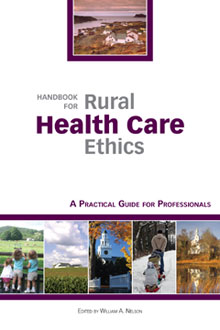 Handbook for Rural Health Care Ethics: A Practical Guide for Professionals
Health care delivered in a rural context poses unique ethics considerations for professionals. In rural areas, small community clinics and hospitals operate in a closely-knit and tightly interdependent setting, one in which over-lapping relationships, disease stigma, and boundary issues are commonplace. It can be difficult for a clinician to protect a patient's privacy when medical care is delivered in a clinic where the patient's neighbors and relatives may work. Similarly, the clinician-patient relationship may become awkward or complicated when the patient is the provider's former teacher, best friend, or a member of the same local parish. Because of the unique rural context, the solutions that health care professionals develop to address complex ethics conflicts may differ from those proposed by their urban, resource-rich, academic oriented colleagues. The Handbook for Rural Health Care Ethics addresses common rural ethical challenges, and offers practical strategies, using a case-based approach, to recognize, resolve, and prevent ethics conflicts. The Handbook, edited by William A. Nelson, was authored by physicians, nurses, health care ethicists, and hospital administrators, all of whom possess scholarship, experience, and expertise in rural-focused ethics. The Handbook was funded by a grant from the National Institutes of Health (NIH) National Library of Medicine.
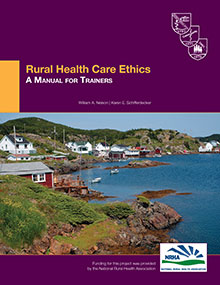 Rural Health Care Ethics: A Manual for Trainers
The purpose of this Training Manual is to provide training guidance and educational resources to enhance multidisciplinary rural professionals' ability to respond effectively, to complex ethical conflicts. The Manual provides practical, programmatic guidance and resources for training coordinators or ethics educators interested in conducting rural health care ethics training workshops, classroom teaching, or sessions imbedded within larger conferences. It does so by providing step-by-step guidelines and education resources, such as case studies and hand-outs for a workshop or conference session on rural health care ethics. Ultimately, the goal of the Training Manual is to increase awareness and understanding of health care ethics issues and to assist rural health care professionals in the identification and/or development of local ethics resources to manage ethical issues in their practice.